
France by Road Trip: 10 Nature Stops to Experience
- Published on
From the vertiginous gorges of the South to the volcanoes of the Auvergne, from the wave-battered Brittany coastline to the pure-water Alpine lakes, France unfolds a rare diversity of landscapes within a single territory. A road trip through France lets you connect these wonders at your own pace, sleeping as close to nature as possible. Are you planning your itinerary, between hikes, swims, and responsible bivouacking?
Our selection of ten stops guides you from one region to the next, with a certified eco-friendly campsite at every stop, so you can travel in harmony with nature!

Gorges du Verdon: Europe’s largest canyon
Carved by the river of the same name, the gorges du Verdon plunge as deep as 700 metres between limestone cliffs. The site attracts around a million visitors every year, drawn in by its emerald waters. The Route des Crêtes and the Corniche Sublime offer magnificent viewpoints, while the lac de Sainte-Croix, France’s third-largest lake, is ideal for canoeing and swimming. It’s a spectacular first stop to kick off a road trip through France.
Visitors’ favourite: the canoe trip at the foot of the cliffs, starting from the lac de Sainte-Croix.
Discover our nature campsites in the Gorges du Verdon!
Dune du Pilat: Europe’s highest sand dune
Facing the banc d’Arguin sandbank, at the entrance to the bassin d’Arcachon, the dune du Pilat rises as a mountain of sand reaching around 110 metres. It’s the highest dune in Europe, in constant motion under the effect of wind and tides. From the summit, the view takes in the Landes forest on one side and the ocean on the other. The climb rewards the effort with a unique panorama, best enjoyed at sunset when the light turns the sand gold.
Visitors’ favourite: the sunset from the ridge, between ocean and pine forest.
Discover our eco-friendly campsites on the Bassin d’Arcachon!
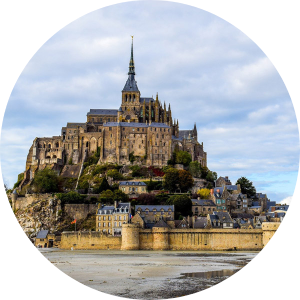
Mont-Saint-Michel: the abbey amid the great tides
Perched on its rock at the head of a bay swept by Europe’s greatest tides, Mont-Saint-Michel raises its thousand-year-old abbey towards the sky. A Unesco World Heritage Site, it enchants through the contrast between the sea, the mudflats, and the Gothic spire. Crossing the bay on foot with a guide reveals a unique ecosystem of quicksand and salt marshes. It’s a stop steeped in history, well worth including on the route between Bretagne and Normandie.
Visitors’ favourite: the guided crossing of the bay, barefoot in the sand, facing the Mont.
Discover our eco-friendly campsites in Bretagne!
Presqu’île de Crozon: the wild cliffs of Finistère
Jutting into the Atlantic in the heart of the Parc naturel régional d’Armorique, the presqu’île de Crozon lines up jagged cliffs, secret beaches, and wind-battered moorland. The pointes de Pen-Hir and de Dinan rank among the finest panoramas of Bretagne, with their rocks rising straight out of the sea. The coastal paths of the GR34 run through unspoilt nature, ideal for hiking. This Breton stop brings a road trip through France a dose of sea air and wide open spaces.
Visitors’ favourite: the pointe de Pen-Hir and its Tas de Pois, those rocks rising out at sea.
Discover our green campsites in Finistère!
Gorges de l’Ardèche: canoeing under the Pont d’Arc
A national nature reserve, the gorges de l’Ardèche unfurl 30 kilometres of meanders between limestone cliffs riddled with caves. The Pont d’Arc, a natural arch spanning 54 metres, marks the entrance to the canyon. Canoeing remains the star activity, on clear water dotted with pebble beaches. The viewpoints along the scenic route offer non-paddlers sweeping views over the river. It’s an ideal natural playground for sporty families.
Visitors’ favourite: paddling under the arch of the Pont d’Arc, drifting downstream.
Route des Crêtes des Vosges: the panoramas of the Grand Est
At the heart of the massif des Vosges, the Route des Crêtes follows a line of rounded summits known as ballons. This high-altitude route links the highland pastures, the ferme-auberges, and the valley lakes, with views that stretch as far as the Black Forest and the Alps on a clear day. The Grand Ballon, the massif’s highest peak, forms its high point. Between fir forests and mountain meadows, this stop brings freshness and wide horizons to a route across eastern France.
Visitors’ favourite: a marcaire meal at a highland ferme-auberge, facing the ballons.
Volcans d’Auvergne: the Unesco-listed chaîne des Puys
Stretching over some thirty kilometres, the eighty volcanoes of the chaîne des Puys form a landscape unlike anywhere else in the world. The puy de Dôme, reachable on foot or by rack railway, towers over the region at 1,465 metres. The wooded cones, craters, and volcanic panoramas make for a magnificent geological stop, between hiking and paragliding.
Visitors’ favourite: the 360° panorama over the volcanic cones from the summit of the puy de Dôme.
Discover our eco-friendly campsites in Auvergne!
Calanques de Cassis: the coves of the national park
Between Marseille and Cassis, the Parc national des Calanques protects a string of coves cut deep between white cliffs and pines. The turquoise waters of the calanques d’En-Vau, de Port-Pin, and de Sormiou can be reached on foot via steep paths or by boat from the port of Cassis. This preserved Mediterranean landscape imposes its own rules to protect fragile nature, with access sometimes restricted in summer. It’s a swimming and hiking stop that leaves a lasting mark on any road trip through France via Provence.
Visitors’ favourite: arriving on foot above the calanque d’En-Vau, its turquoise waters below.
Discover our green campsites in Provence!
La Camargue: the wild delta of pink flamingos
Between the two branches of the Rhône and the Mediterranean, the Camargue unfolds a delta of lagoons, marshes, and rice paddies listed as a Parc naturel régional. This unique territory is home to pink flamingos, bulls, and the famous white horses, in a nature shaped by water and salt. The bird-watching observatories of the parc du Pont de Gau let you get close to exceptional birdlife. By bike or on horseback, you cross these flat expanses while respecting a protected, fragile ecosystem.
Visitors’ favourite: the flight of pink flamingos over the lagoons, in the light of the setting sun.
Lac d’Annecy: pure waters at the foot of the Alps
Renowned as one of Europe’s purest lakes, the lac d’Annecy shimmers at the foot of the Savoie mountains. A 40-kilometre greenway circles it, by bike or on foot, along clear waters well suited to swimming. The villages of Talloires and Duingt, the château de Menthon, and the landscaped beaches line its shores. This final Alpine stop combines watersports, cycling tourism, and mountain panoramas, in a setting preserved through exemplary water management.
Visitors’ favourite: cycling around the lake on the greenway, between turquoise water and peaks.
You now have the ten finest nature stops for a road trip through France, from the gorges du Verdon to the lac d’Annecy. Book your stays in our campsites now and travel across France from one natural site to another, in keeping with a responsible approach!
FAQ – Road Trip Through France
How much time should you plan for a road trip through France?
It all depends on the stops chosen. Allow two to three nights per major region to enjoy the sites without spending too much time on the road. A complete itinerary linking several regions is best savoured over two to three weeks.
What’s the best season for a nature road trip?
Spring and early autumn offer mild temperatures and moderate crowds at most sites. Summer is good for swimming, but requires booking accommodation in advance and anticipating crowds in the gorges and calanques.
Can you take a road trip through France in an eco-friendly way?
Yes, by limiting long driving stretches, favouring soft mobility once on site, and choosing certified accommodation. Many campsites committed to a responsible approach are dotted across the major natural regions.
Should you book campsites in advance for a road trip?
In peak season, it’s strongly advisable to book ahead, especially near the busiest sites. Planning ahead lets you secure pitches at certified campsites, which are often fully booked in summer in tourist regions.
Related articles


Our camping selection


