Slow Tourism Definition: Understanding the Movement’s 4 Pillars
- Published on
Slow tourism refers to a way of travelling that favours slowness, proximity and immersion. Born in Italy in the wake of Slow Food, this movement responds to the saturation of mass tourism. You take your time: fewer destinations, more local experiences and a reduced carbon footprint. Eco-friendly camping fits fully into this approach. It relies on gentle mobility, local producers and the preservation of living things.
This article gives you all the basics!
Key takeaways
- Slow tourism promotes a slow, local and respectful way of travelling.
- Its origins trace back to the Italian Slow Food movement, launched in 1986.
- The 4 pillars are slowness, local roots, sobriety and authenticity.
- A slow stay favours the train, cycling and eco-friendly accommodation.
What is slow tourism?
Slow tourism is a travel approach that values quality over quantity. You choose to stay longer in the same destination. You discover places at a human pace, without chasing checklists of monuments.
The concept was born in Italy in the late 1980s. It extends the Slow Food movement founded by Carlo Petrini. The idea has spread to other areas of everyday life, from gastronomy to design to towns (Cittaslow).
Unlike express tourism, slow tourism doesn’t try to tick off as many sites as possible. It favours immersion, encounters and respect for ecosystems. It’s also a way of travelling that can be practised close to home, without flying.
The 4 main principles of slow tourism
The 4 main principles of slow tourism structure the approach. These fundamentals change the way you build a trip. You’re no longer trying to maximise the number of sites visited, but to experience them fully.
Here are the 4 principles to keep in mind:
- Travelling slowly means choosing fewer destinations and staying longer in each.
- Relying on local businesses supports producers, craftspeople and small-scale accommodation providers.
- On the sobriety side, slow tourism limits air travel and disposable equipment.
- Authenticity opens the door to encounters with locals rather than standardised tours.
Why choose slow tourism for your holiday?
Choosing slow tourism concretely reduces your footprint. According to ADEME (the French environment and energy agency), tourism accounts for 11% of greenhouse gas emissions in France. Transport takes up the largest share, well ahead of accommodation or activities.
Beyond climate impact, slow tourism offers other benefits for travellers and regions:
- Supporting the local economy by spending directly with producers and craftspeople.
- Preserving biodiversity by limiting visitor numbers to fragile sites.
- Living richer experiences thanks to the time spent on site.
- Reducing travel fatigue by avoiding repeated journeys.
- Meeting locals and getting off saturated tourist routes.
Putting slow tourism into practice in France
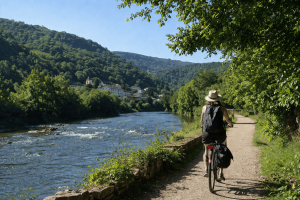
France is perfectly suited to practising slow tourism. Nature parks, greenways and award-winning villages offer plenty of opportunities. Choose a region, get there by train or bike, and settle in for a week or more.
A few concrete ideas for a first slow trip:
- Cycle along a cycle route such as the Vélodyssée, the Canal des Deux Mers or the ViaRhôna.
- Hike the trails of the Haut-Jura or Cévennes regional nature parks.
- Stay at an eco-friendly campsite awarded the Green Key or EU Ecolabel.
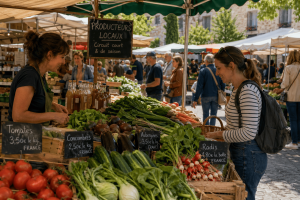
- Buy directly from producers: AMAP box schemes, farmers’ markets, farm shops.
- Extend your stay to 10 or 14 days to reduce the number of round trips.
Feedback from the field: travellers who extend their stay beyond 7 days notice a shift in pace and perception. The first few days remain devoted to discovery. From day 5 onwards, familiar places become ripe for encounters. Locals recognise regular visitors, producers recommend their neighbours, an informal network forms. This shift alone justifies the philosophy of slow tourism.
Ready to slow down to travel better? Compare over 430 accommodations on our site, from Auvergne-Rhône-Alpes to the PACA region, and get a taste of slow tourism in the heart of nature!
FAQ — Slow Tourism Definition
Who invented slow tourism?
Slow tourism stems from the Slow Food movement founded by Carlo Petrini in 1986 in Bra, in the Italian Piedmont region. The idea then spread to many areas, including travel. The term slow tourism became popular in the 2000s, championed by networks such as Slow Travel Berlin and Slow Movement International.
What’s the difference between slow tourism and ecotourism?
The difference between slow tourism and ecotourism lies mainly in scope. Ecotourism targets the preservation of natural environments and awareness-raising. Slow tourism encompasses slowness, local roots and authenticity, in addition to ecology. The 2 approaches often overlap in travellers’ concrete practices.
Is slow tourism more expensive?
No, slow tourism isn’t necessarily more expensive than conventional tourism. Staying longer in the same place reduces transport and accommodation costs. Local products sometimes cost more per unit but involve less overall consumption. The overall budget remains comparable, or even lower.
What certifications should you look for a slow stay?
Several certifications help identify accommodation aligned with slow tourism. The Green Key and the EU Ecolabel guarantee verified eco-friendly practices. The Home Paysan label highlights local roots and educational farms. ACSI éco-responsable distinguishes campsites committed to a sustainable approach.
Is slow tourism suitable for families?
Yes, slow tourism is perfectly suited to families with children. The slower pace reduces travel fatigue and logistics. Children enjoy building landmarks: finding the same bakery again, recognising producers, walking through the same woods several times. This approach turns a holiday into a memorable experience.
Related articles


Our camping selection