
Blog
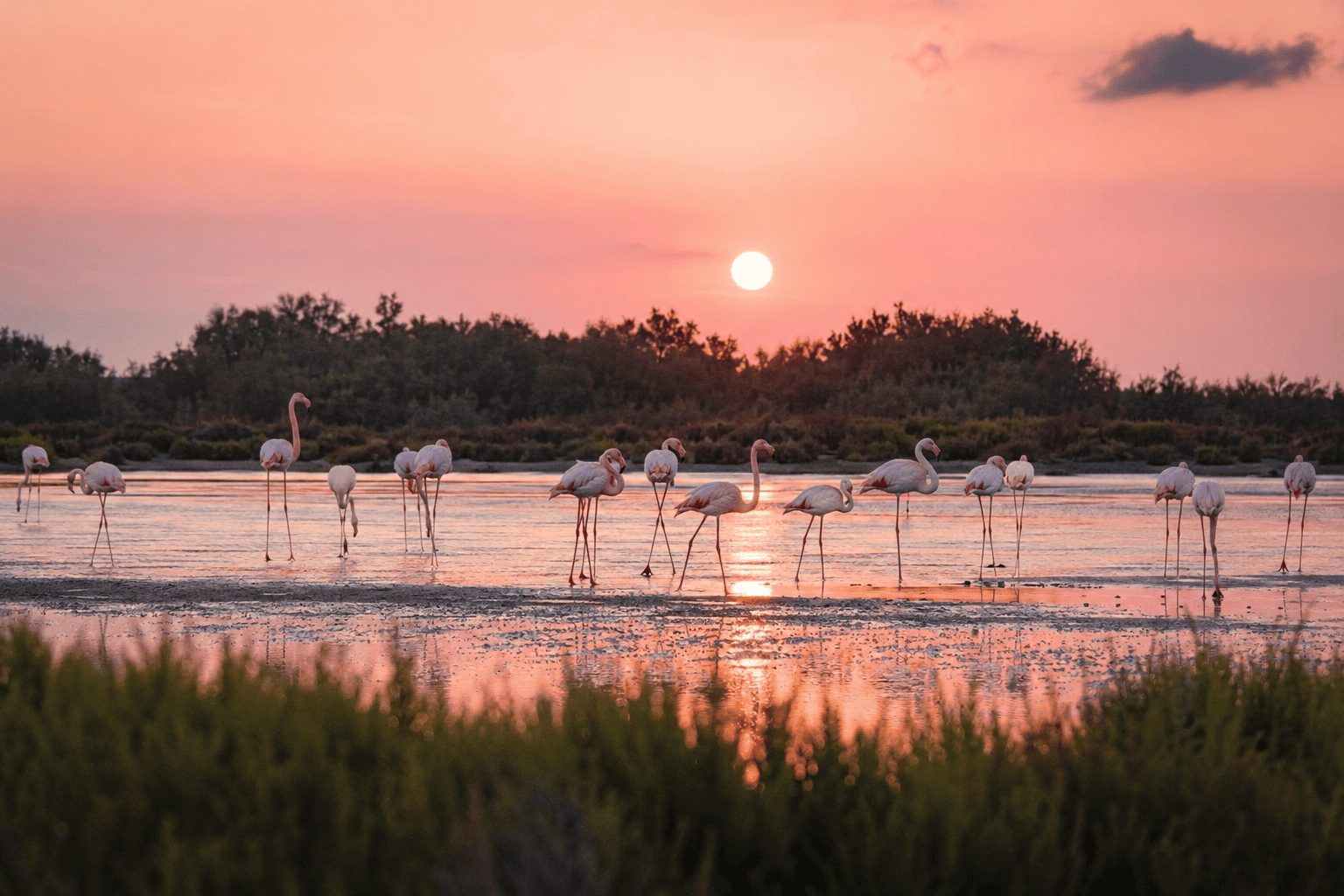
The Camargue forms a vast delta protected by a Parc naturel régional covering 100,000 hectares, between Arles, Aigues-Mortes, and the Mediterranean. This territory, designated a biosphere reserve by UNESCO, is home to nearly 400 bird species. Visiting this fragile environment calls for gentle practices that respect both nature and local communities. On our eco-friendly campsite comparison site, 44 certified eco-responsible campsites in the Provence-Alpes-Côte d’Azur region make an ideal base for exploring the delta.
Here are 8 recommended visits for a discovery in keeping with the spirit of the place!
Located north of Saintes-Maries-de-la-Mer, the parc ornithologique du Pont de Gau spans 60 hectares of managed marshland. Several kilometres of marked trails let you observe pink flamingos, herons, egrets, and storks in their natural habitat. The park also takes in injured birds of prey rescued from the delta. Allow 2 to 3 hours to complete the visit at a leisurely pace, binoculars around your neck.
Visitors’ favourite: watching the pink flamingos at sunrise, when the low light sets their pale pink plumage aglow.
Practical information:
The étang de Vaccarès forms the largest body of water in the Camargue, spanning 6,500 hectares. At the heart of the national nature reserve managed by the Société nationale de protection de la nature, this lagoon is home to hundreds of migratory bird species. Several free observation trails run along its banks, including the Capelière and the Digue. Cycling is the way to go to respect the site’s tranquillity, far better than a car on the narrow tracks.
Visitors’ favourite: the Capelière trail at sunset, with its discreet boardwalks and observation posts perfectly blended into the landscape.
Practical information:
Aigues-Mortes raises its medieval ramparts on the western bank of the delta, at the edge of the Gard. Built on the orders of Louis IX in the 13th century as a crusader port, the city preserves one of the best-preserved fortified enclosures in France. You can climb up onto the wall-walks and make a full circuit of the fortifications. Inside, several producers of Camargue salt keep shop along the old streets.
Visitors’ favourite: the Tour de Constance and the panoramic view over the pink salt pans from the top of the ramparts, especially late in the day.
Practical information:
The historic capital of the Camargue, Saintes-Maries-de-la-Mer welcomes the great Roma pilgrimage in honour of Sara the Black every May. The fortified 12th-century church, a listed historic monument, houses Sara’s shrine in its crypt. The village packs a bullring, beaches, and a traditional harbour into just a few streets. There you can sample gardiane de taureau (bull stew) or red rice in the bistros of the town centre.
Visitors’ favourite: climbing up to the rooftop terrace of the fortified church, which offers a 360° view over the delta all the way to the Mediterranean.
Practical information:
A hamlet attached to the commune of Arles, Salin de Giraud is home to one of the largest salt-producing sites in Europe, covering 11,000 hectares. The summer harvest brings forth the famous salt pyramids or “camelles,” some of which rise more than 20 metres high. The saltworks offers little train rides along the ponds. Pink flamingos frequent these plankton-rich brackish waters, the site’s visual signature.
Visitors’ favourite: the panoramic viewpoint over the camelles, especially at sunset when the salt turns the light pink.
Practical information:
Manades are the traditional livestock farms of the Camargue, where white horses and black bulls live in semi-freedom across vast plots of land. More than 80 manades are scattered across the delta, around a dozen of which regularly open their doors to the public. There you can watch the ferrade (branding), the sorting of the bulls, and sometimes a demonstration by a gardian on horseback. Some manades also offer horseback rides through the sansouires and salt marshes.
Visitors’ favourite: the horseback ride along the edge of a lagoon, to feel the vastness of the delta far from the tourist routes.
Practical information:
The Digue à la Mer links Saintes-Maries-de-la-Mer to the Beauduc lighthouse over some twenty kilometres, along the Mediterranean coast. Built in the late 19th century to protect farmland, it’s now closed to motorised vehicles. By bike, on foot, or on horseback, you cross salt marshes, sansouires, and deserted beaches. The track stays flat, birdlife is everywhere, and the calm is total.
Visitors’ favourite: passing by the Gacholle lighthouse, right in the heart of the reserve, where you often come across flamingos and wild horses.
Practical information:
At the far south of the Gard, the plage de l’Espiguette unfurls more than 10 km of fine sand and shifting dunes, in perfect ecological continuity with the Camargue. Listed as a protected Natura 2000 site, it remains free of buildings along most of its length. The car park sits at the entrance, then you walk east to reach the wildest areas. The Espiguette lighthouse marks the eastern end, reachable on foot or by bike.
Visitors’ favourite: the long walk to the lighthouse at sunset, when the pink-tinged dunes and grazing Camargue horses create a striking scene.
Practical information:
Convinced by the idea of visiting the Camargue the gentle way? Choose an eco-friendly campsite in the Provence-Alpes-Côte d’Azur region or in Occitanie to reach the delta in under an hour. Your next responsible holiday just needs a departure date!