

Blog
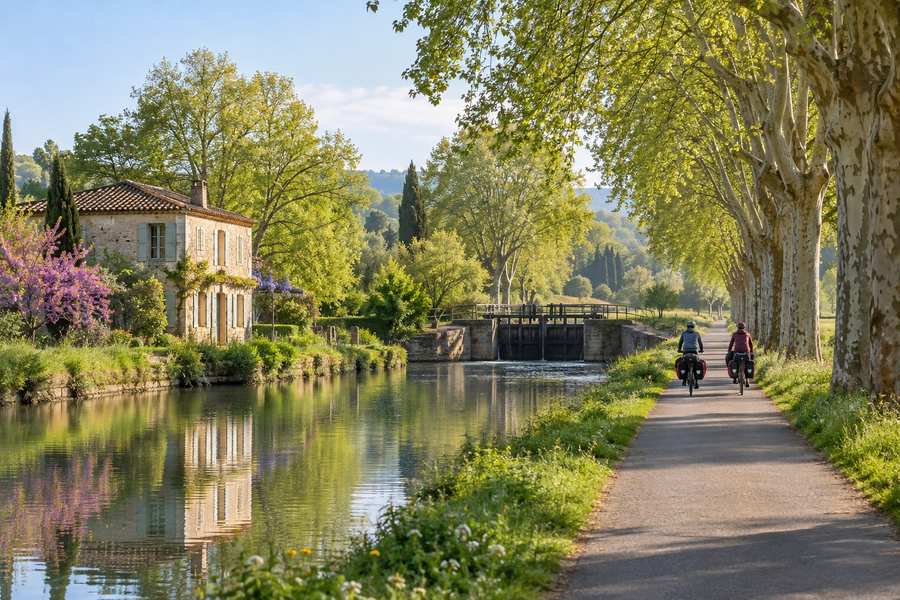
A voie verte is a road reserved for pedestrians, cyclists, skaters and horse riders, and closed to all motor vehicles. Often built on former railway lines or towpaths, these flat, safe routes are ideal for discovering a region by bike as a family, away from traffic.
Here is exactly what a voie verte is, how it differs from a véloroute or a cycle path, France’s most beautiful routes and our tips for cycling from a campsite.
| Information | In brief |
|---|---|
| Definition | Road reserved for non-motorised vehicles, pedestrians and horse riders (French Highway Code, since 2004) |
| Users | Walkers, cyclists, skaters, people with reduced mobility, horse riders |
| Route | Former railway lines, towpaths, canal banks |
| Profile | Flat or gently sloping, paved or compacted |
| Major routes | La Loire à Vélo, La Vélodyssée, ViaRhôna, the Canal des Deux Mers |
| Sign | Green square sign with pedestrian and cyclist (C115) |
In France, the voie verte was introduced into the French Highway Code by a decree of 16 September 2004. It is defined there as a road “exclusively reserved for the use of non-motorised vehicles, pedestrians and horse riders”. In practice, no car, scooter or quad uses it, apart from maintenance and emergency vehicles.
Most voies vertes follow disused railway lines or towpaths along rivers and canals. The result: very gentle gradients, long shaded straights, and old stations or lock-keepers’ cottages converted into cafés, holiday lets or bike hire shops.
On a voie verte, the golden rule is sharing: faster users give way to slower ones, you signal when you overtake and keep to the right.
The France Vélo Tourisme website lists these routes, with maps, stages and services carrying the Home Vélo label.
The campsite is the ideal base for exploring a voie verte: pitch your tent or rent accommodation, then ride out each day without taking the car. Many sites carry the Home Vélo label, with secure storage, repair kits and bike hire.
On the Atlantic coast, the camping de Prigny, in Les Moutiers-en-Retz, lies on the route of the Vélodyssée. Further south, the camping L’Arbre d’Or, in Parentis-en-Born, by the lake and in the heart of the Landes forest, gives access to the coastal cycle paths. On the Île de Ré, criss-crossed with cycle paths, the camping de l’Île Blanche, in La Flotte, makes it possible to do everything by bike. Near Saumur, the camping Les Nobis d’Anjou, in Montreuil-Bellay, is a good stop for joining the Loire à Vélo.
The voie verte is arguably the best way to travel slowly: no cars, little climbing, landscapes passing at the pace of the pedals. With children, choose stages of 20 to 30 kilometres and a campsite on the route or very close by. It is also a simple way to reduce the carbon footprint of your holiday without giving up the pleasure of discovery.
It is a road reserved exclusively for non-motorised vehicles, pedestrians and horse riders, under the French Highway Code since a decree of 16 September 2004.
The voie verte is a dedicated route shared by all non-motorised users. The véloroute is a long-distance cycle route that uses voies vertes but also quiet minor roads.
Yes, the voie verte is shared by pedestrians, cyclists, skaters and horse riders. Faster users must give way to slower ones and signal when they overtake.
Yes, an electrically assisted bicycle counts as a cycle under the Highway Code. Motorised vehicles such as scooters, motorbikes or quads are, however, banned.
La Loire à Vélo, La Vélodyssée on the Atlantic coast, ViaRhôna and the Canal des Deux Mers by bike are among the most popular routes.
It is compulsory for children under 12, whether driving or riding as a passenger, and strongly recommended for adults.
Campsites marked “Partner” are Aimer Camper members and are shown first. All results match your search.